How integrated visibility is closing the gap between field activity and operational accountability.
AT THE START OF A SHIFT, THE JOB SEEMS MANAGEABLE. The driver knows the route. The equipment is running. The day feels like the hundreds that came before it. But out on that route, things happen that no one fully sees, no one fully records, and no one can easily explain when questions come up later.
A container is blocked, but nothing is noted. A load arrives contaminated, but no one can tie it to a specific address. A customer swears a stop was missed. A minor incident happens at the edge of a parking lot, and by the time anyone asks about it, the details are vague or completely unknown.
None of these situations are rare. They are part of the daily reality of waste collection. The problem is not that they happen. The problem is that in most operations, there is no consistent way to verify what actually occurred. That gap between what happens in the field and what can be proven afterward has become one of the more stubborn challenges the waste industry is trying to work through right now.
The Bar has Moved
Compliance in the waste industry used to be more straightforward. If routes got completed and major problems were avoided, most operations were considered to be in reasonable shape. Paperwork existed, but it often played a secondary role to the work itself. That is no longer the case.
Today, compliance touches safety, service verification, contamination control, route adherence, and customer accountability. Increasingly, it is not enough to believe these things are being handled correctly. Operators are expected to show it. That expectation is coming from every direction at once.
Municipal contracts require documentation. Regulators want records that can hold up to scrutiny. Customers expect fast, specific answers when something goes wrong. Insurance carriers strongly prefer, and often require, evidence of active risk management, not just good intentions.
The pressure is not just to run a solid operation. It is to prove, on demand, that you did.
Where Manual Documentation Breaks Down
Most operations still depend on some mix of driver reporting, customer feedback, and after-the-fact investigation to understand what happened on route. Those methods can work in isolated situations, but at scale, they quickly fall apart.
Drivers cannot document everything without adding distraction and time to a job that is already physically and mentally demanding and on tight deadlines. Customer complaints represent one side of the story, often the most agitated one. And when an incident gets reviewed a day or two later, the available information may be incomplete. The result is a pattern that most operations managers recognize.
Time gets spent chasing details that should already be captured. Decisions get made with limited context. Disputes drag on because no one has the full picture. In a high-volume operation, those inefficiencies compound quickly, and the costs are real, in hours, in claims, and in customer relationships that erode.
Recording Video Is not the Same as Understanding What Happened
The industry has responded by putting cameras on trucks. That was a logical step, and in many cases, it helped. But not all camera deployments are solving the same problem. A camera that records footage without connecting that footage to the operation itself does not close the visibility gap. It just moves the problem. Instead of not knowing what happened, you now have video somewhere in a system that someone has to find, pull, and review after the fact. The difference comes down to whether visual data is tied to the work being done.
When systems are designed to automatically capture service events, associate them with location and time, and link them to specific stops or customers, visibility starts to become accountability. A completed service is no longer a matter of driver recollection, but a recorded event with a timestamp and a location. A contaminated load can be tied to a specific customer rather than addressed broadly. An incident at a stop can be reviewed with actual context, not pieced together from memory and guesswork.
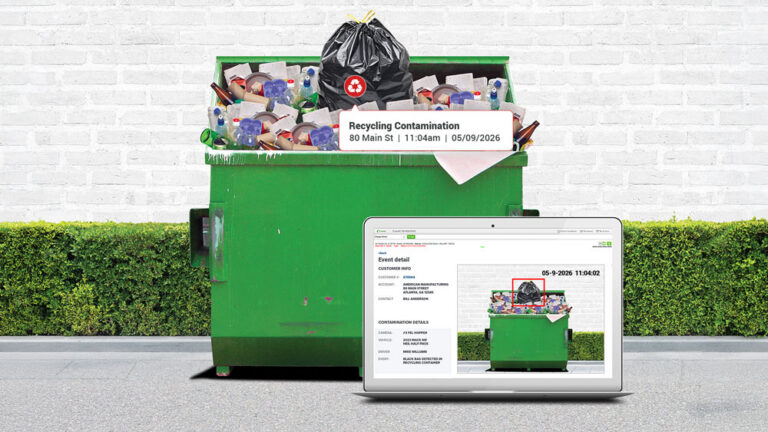
Commercial recycling contamination event.
That is the shift that matters. From documentation as an afterthought to documentation as a built-in part of how the operation runs. Some systems are built around exactly that idea. Rather than depending on manual input from drivers, service activity is captured passively in the background as part of normal operation. Images, video, and event data are tied directly to the stop, creating a consistent and objective record without adding anything to the driver’s workload. For the first time, what happened at a specific location can be answered with certainty rather than interpretation.
What this Looks Like in the Field
The practical impact shows up most clearly in the situations that used to be the hardest to manage. In residential and commercial collection, service verification becomes straightforward. Disputed stops are no longer a back-and-forth between the driver and the customer. There is a record, tied to a location and a time, that resolves the question.
Contamination programs become more precise. Instead of addressing the problem at a general level, operators can identify which customers are responsible and have a documented basis for the conversation. That changes how the program gets enforced and how customers respond to it.
At transfer stations and materials recovery facilities, load conditions and handling practices can be reviewed with real context. Patterns that would otherwise take months to surface can be identified and addressed earlier.
At landfills, documentation of incoming loads and site activity creates a clearer record for internal review and regulatory response. Across all of these environments, the common thread is the same. Less guesswork. Fewer assumptions. Faster answers when questions arise.
Safety incident event.
Integration is What Makes it Stick
Where this approach becomes more than a documentation upgrade is when it connects with the rest of how the operation runs. When field data flows directly into platforms like Soft-Pak, it becomes part of the daily workflow rather than something that needs to be retrieved separately and cross-referenced. Customer service teams can answer inquiries with verified information instead of hedging. Operations managers can see what is happening across routes without waiting on reports. Exceptions get captured as they occur rather than reconstructed later.
That changes how time gets spent at every level of the organization. Less of it chasing information. More of it acting on what the information shows.
Safety Programs Work the Same Way
Coaching improves when it is based on actual events rather than general reminders. Drivers can see what happened, understand the context around it, and make adjustments that are grounded in a specific situation rather than a broad policy reminder. That kind of coaching tends to stick in ways that generic instruction does not.
At the same time, when documentation happens automatically in the background, it removes a layer of friction from the cab. Drivers are not being asked to photograph conditions or log exceptions while they are operating. The system handles it. They can focus on the job.
That balance matters more than it might seem. Technology that adds to the burden of an already demanding job tends to get worked around. Technology that supports the job without adding to it tends to get used.
A Different Model of Compliance
What is taking shape across the better-performing operations is a different way of thinking about compliance altogether. It is not built around periodic audits, end-of-day reports, or spot checks after the fact. It is built around continuous visibility, where operational activity is captured consistently, connected to the systems that run the business, and available when it is needed.
That does not replace training, policy, or human judgment. It gives those things a clearer foundation. When managers know what is happening in the field, training programs can be more targeted, policies can be enforced more consistently, and accountability has something real to stand on. Over time, that clarity produces more consistent service, stronger safety outcomes, and fewer disputes that drag on without resolution.
Where the Industry is Headed
Waste collection has always been defined by physical work in conditions that change constantly. That part of the business is not going away. What is changing is the level of visibility available to manage it. Expectations from customers, municipalities, and regulators are not going to lessen. The gap between what happens on route and what can be demonstrated afterward is becoming harder to live with. Operations that continue to rely primarily on manual processes and after-the-fact review will find it increasingly difficult to keep pace with what is being asked of them.
Those that have invested in integrated visibility are building toward something more stable: an operation where questions can be answered quickly, performance can be verified, and compliance is supported by the same data that moves the business forward every day. That shift is already underway. The only real question is how far behind it is worth falling before making it.
3rd Eye® is a leading provider of smart camera systems and AI-driven fleet intelligence designed specifically for the solid waste and recycling industry. 3rd Eye develops seamlessly integrated technology that combines advanced cameras, artificial intelligence, and real-time data to improve safety, operational efficiency, service verification, regulatory compliance, and overall fleet profitability, all without adding workload for drivers. 3rd Eye’s solutions provide fleet managers with clear, objective visibility into what happens in the field, turning everyday collection and roll-off activity into actionable insight that supports better decisions across operations, maintenance, safety, and customer service. As part of the Environmental Solutions Connected Collections ecosystem, 3rd Eye works seamlessly alongside Soft-Pak® waste hauler software, Heil® refuse bodies, and Marathon® Equipment compactors and recycling equipment to bring technology, AI, and equipment together, helping fleet owners make better decisions, faster.