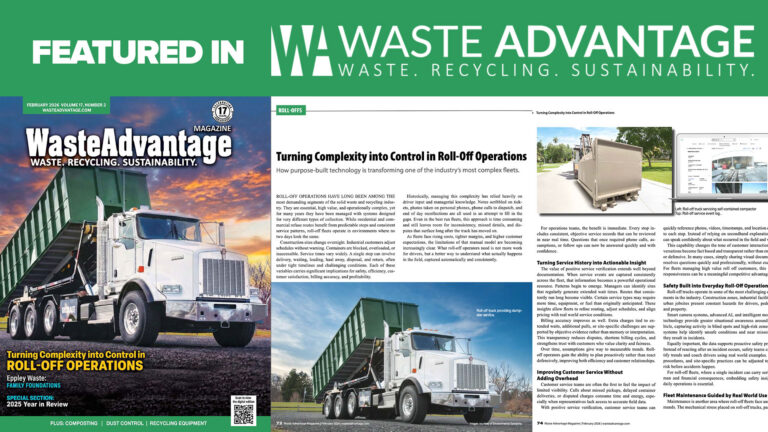
How Purpose-Built Technology Is Transforming One of the Industry’s Most Complex Fleets
Courtesy of Waste Advantage Magazine | February, 2026 Issue
Roll-off operations have long been among the most demanding segments of the solid waste and recycling industry. They are essential, high-value, and operationally complex, yet for many years, they have been managed with systems designed for very different types of collection. While residential and commercial refuse routes benefit from predictable stops and consistent service patterns, roll-off fleets operate in environments where no two days look the same.
Construction sites change overnight. Industrial customers adjust schedules without warning. Containers are blocked, overloaded, or inaccessible. Service times vary widely. A single stop can involve delivery, waiting, loading, haul away, disposal, and return, often under tight timelines and challenging conditions. Each of these variables carries significant implications for safety, efficiency, customer satisfaction, billing accuracy, and profitability.
Historically, managing this complexity has relied heavily on driver input and managerial knowledge. Notes scribbled on tickets, photos taken on personal phones, phone calls to dispatch, and end-of-day recollections are all used in an attempt to fill in the gaps. Even in the best run fleets, this approach is time-consuming and still leaves room for inconsistency, missed details, and disputes that surface long after the truck has moved on.
As fleets face rising costs, tighter margins, and higher customer expectations, the limitations of that manual model are becoming increasingly clear. What roll-off operators need is not more work for drivers, but a better way to understand what actually happens in the field, captured automatically and consistently.
Why Roll-Off Fleets Demand a Different Technology Model
One of the most common mistakes in fleet technology is treating roll-off trucks as simply variations of residential or commercial units. In reality, roll-off operations function in fundamentally different ways at almost every level.
Routes are lower volume but higher consequence. Service exceptions are frequent. Containers are staged at sites with limited access, uneven terrain, and constantly changing conditions. Drivers are expected to operate complex equipment safely while adapting on the fly, often under pressure to stay on schedule.
Traditional fleet management systems struggle to reflect this reality. Manual service verification places a heavy burden on drivers and introduces subjectivity. Generic telematics provide location data but little context. Dispatchers, customer service teams, and managers are often forced to manually reconstruct events after the fact, piecing together incomplete information from multiple sources.
The downstream effects are felt across the organization. Customer service teams field calls without full context. Accounting manages disputed invoices without defensible documentation. Operations lacks reliable data to improve routing, pricing, or resource allocation. Drivers feel increasing pressure to document more while already managing demanding workloads.
Positive Service Verification Designed for Roll-Off Reality
Positive Service Verification technology from 3rd Eye was developed specifically for roll-off operations, aligning technology with how these fleets actually work in the field.
Rather than relying on manual inputs, the system uses passive event detection to automatically identify service activity throughout the route. Time stamped, geo located photos and video create a clear visual record of each stop, capturing delivery, pickup, wait time, and site conditions without requiring any action from the driver.
This hands off approach is intentional. Roll-off drivers operate in complex, often hazardous environments. Asking them to stop, log events, or trigger systems introduces distraction and increases risk. Positive Service Verification works quietly in the background, allowing drivers to focus on safe and efficient operation while documentation happens automatically.
For operations teams, the benefit is immediate. Every stop includes consistent, objective service records that can be reviewed in near real time. Questions that once required phone calls, assumptions, or follow ups can now be answered quickly and with confidence.
Learn more about Service Verification Solutions
Turning Service History Into Actionable Insight
The value of Positive Service Verification extends well beyond documentation. When service events are captured consistently across the fleet, that information becomes a powerful operational resource.
Patterns begin to emerge. Managers can identify sites that regularly generate extended wait times. Routes that consistently run long become visible. Certain service types may require more time, equipment, or fuel than originally anticipated. These insights allow fleets to refine routing, adjust schedules, and align pricing with real world service conditions.
Billing accuracy improves as well. Extra charges tied to extended waits, additional pulls, or site specific challenges are supported by objective evidence rather than memory or interpretation. This transparency reduces disputes, shortens billing cycles, and strengthens trust with customers who value clarity and fairness.
Over time, assumptions give way to measurable trends. Roll-off operators gain the ability to plan proactively rather than react defensively, improving both efficiency and customer relationships.
Improving Customer Service Without Adding Overhead
Customer service teams are often the first to feel the impact of limited visibility. Calls about missed pickups, delayed container deliveries, or disputed charges consume time and energy, especially when representatives lack access to accurate field data.
With Positive Service Verification, customer service teams can quickly reference photos, videos, timestamps, and location data tied to each stop. Instead of relying on secondhand explanations, they can speak confidently about what occurred in the field and why.
This capability changes the tone of customer interactions. Conversations become fact based and transparent rather than emotional or defensive. In many cases, simply sharing visual documentation resolves questions quickly and professionally, without escalation.
For fleets managing high value roll-off customers, this level of responsiveness can be a meaningful competitive advantage.
Learn more about Customer Service Technology Solutions
Safety Built Into Everyday Roll-Off Operations
Roll-off trucks operate in some of the most challenging environments in the industry. Construction zones, industrial facilities, and urban job sites present constant hazards for drivers, pedestrians, and property.
Smart camera systems, advanced AI, and intelligent monitoring technology provide greater situational awareness around the vehicle, capturing activity in blind spots and high risk zones. These systems help identify unsafe conditions and near misses before they result in incidents.
Equally important, the data supports proactive safety programs. Instead of reacting after an incident occurs, safety teams can identify trends and coach drivers using real world examples. Routes, procedures, and site specific practices can be adjusted to reduce risk before accidents happen.
For roll-off fleets, where a single incident can carry serious human and financial consequences, embedding safety insight into daily operations is essential.
Learn more about Safety Technology Solutions for Fleets
Fleet Maintenance Guided by Real World Use
Maintenance is another area where roll-off fleets face unique demands. The mechanical stress placed on roll-off trucks, particularly on hydraulic systems and structural components, is significant.
Traditional maintenance schedules based solely on mileage or calendar intervals often fail to reflect how vehicles are actually used. Connected fleet data adds critical context by correlating real world service activity with equipment stress, helping maintenance teams identify potential issues before they turn into breakdowns.
By understanding how often trucks are lifting, waiting under load, or operating in demanding conditions, maintenance teams can plan service more effectively. Preventive maintenance becomes more targeted, unplanned downtime is reduced, and overall fleet uptime improves.
Visual documentation also helps identify operating conditions that contribute to accelerated wear, allowing fleets to address root causes early rather than reacting to failures after they occur.
Learn more about Fleet Maintenance Software Technology
IFTA Fuel Tax Reporting Without the Guesswork
Fuel tax reporting has long been a challenge for roll-off fleets, particularly those operating across state lines. IFTA compliance depends on accurate tracking of mileage by state, yet traditional reporting methods often rely on manual logs or disconnected systems.
Automated location and mileage data changes that dynamic. By capturing mileage automatically across state lines as part of everyday operations, fleets can generate accurate IFTA reports without adding work for drivers or accounting teams.
This is especially valuable for roll-off operations, where routes may vary daily and cross state boundaries unexpectedly. Automated reporting reduces the risk of errors, audits, and penalties while saving time for staff who would otherwise spend hours reconciling data.
Learn more about IFTA / Fuel Tax Reporting Software for Fleets
Letting Drivers Focus on the Job
One of the most important benefits of a passive, connected technology approach is what it removes from the driver’s day.
Roll-off drivers are highly skilled professionals managing complex equipment in unpredictable environments. Technology that demands constant interaction only increases distraction and frustration.
By automating service verification, safety monitoring, maintenance insight, and mileage tracking, drivers are allowed to focus on what matters most. Safe operation. Efficient service. Reliable execution.
This respect for the driver’s role also supports retention, an increasingly critical concern across the industry.
Setting a New Standard for Roll-Off Fleets
Roll-off operations have long been among the most challenging segments of the waste industry to manage efficiently. As expectations rise and complexity increases, the need for clear, objective operational insight has never been greater.
Technology designed specifically for roll-off fleets is changing what is possible. Automated Positive Service Verification, combined with integrated safety, maintenance, and IFTA reporting, provides roll-off operators with the tools they need to operate confidently in a demanding environment.
For fleets ready to move beyond manual processes and fragmented systems, the future of roll-off operations is already taking shape. It is connected, intelligent, and designed around the realities of the job, quietly improving safety, efficiency, and profitability with every stop.
3rd Eye’s solutions provide fleet managers with clear, objective visibility into what happens in the field, turning everyday collection and roll-off activity into actionable insight that supports better decisions across operations, maintenance, safety, and customer service.
As part of Environmental Solutions’ Connected Collections ecosystem, 3rd Eye works seamlessly alongside Soft-Pak waste hauler software, Heil refuse bodies, and Marathon Equipment compactors and recycling equipment to bring technology, AI, and equipment together, helping fleet owners make better decisions, faster.