Why Commercial Recycling Contamination Has Become a Major Operational Risk
Commercial recycling collection presents one of the most complex operational challenges in the waste and recycling industry. Unlike residential routes, where contamination often goes unnoticed until materials reach a processing facility, commercial recycling involves larger containers, higher volumes, and a much wider range of materials. When contamination occurs on commercial routes, the financial and operational consequences are immediate and significant.
As material recovery facilities enforce stricter standards and regulatory pressure continues to increase, fleets are being held more accountable for what enters the recycling stream. Rejected loads, processing penalties, fines, and customer disputes are becoming routine issues for haulers that lack consistent, defensible contamination documentation. At the same time, traditional manual approaches to identifying contamination are proving to be inadequate and costly for modern refuse fleet operations.
The Growing Impact of Commercial Recycling Contamination
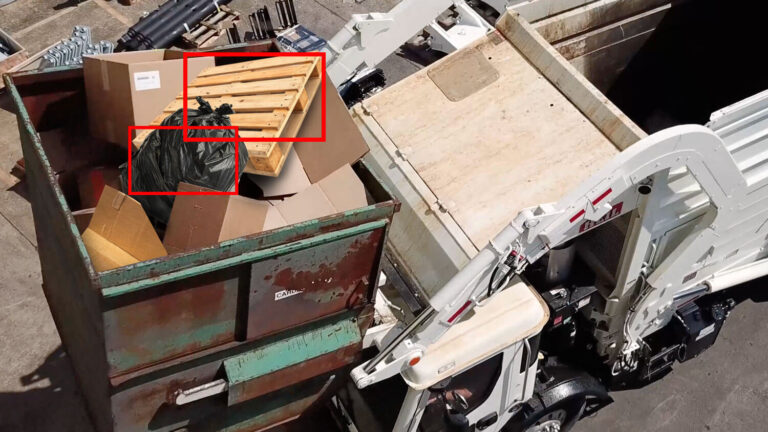
Recycling contamination occurs when non-recyclable or prohibited materials are placed into recycling containers. In commercial settings, this often includes bagged trash, food waste, plastic film, hoses, tires, construction debris, scrap metal, or other materials that cannot be processed through standard recycling systems.
When these materials enter the recycling stream, they create downstream problems that affect the entire value chain. Contaminants increase sorting labor, slow processing lines, damage equipment, and reduce the market value of recovered materials. In many cases, loads that exceed contamination thresholds are rejected entirely, forcing haulers to absorb disposal costs and potential fines.
For commercial waste haulers, contamination is not an isolated issue. It represents an ongoing operational risk that impacts profitability, compliance performance, and customer relationships. As recycling standards tighten, the margin for error continues to shrink.
Why Traditional Contamination Management Falls Short
For decades, contamination management has relied heavily on manual processes. Drivers are expected to identify contamination at the point of collection, document it with photos, and report it back to the office. Supervisors then review those records, attempt to match them to service locations, and determine whether customer education, warnings, or charges are required.
This approach creates several challenges. Driver involvement slows routes and increases safety risk as operators exit the cab and interact with containers, traffic, and equipment. Documentation is inconsistent and often incomplete, making it difficult to defend decisions when customers dispute contamination claims. Office teams are left to manage large volumes of raw data, which delays response times and limits the effectiveness of corrective action.
As route density increases and labor struggles continue, these manual methods become increasingly unsustainable.
The Limits of Manual “Lid Flipper” Programs
Many waste and recycling companies attempt to manage contamination through manual “lid flipper” inspections, where staff drive separate vehicles to randomly check commercial container contents. While intended to be proactive, this approach is labor-intensive, inconsistent, and costly.
Because inspections are infrequent and disconnected from actual service events, they capture only a small snapshot of customer behavior and often miss contamination entirely. Documentation is subjective and difficult to tie to a specific pickup, making customer enforcement and dispute resolution challenging. As route density increases and labor availability tightens, these programs become increasingly difficult to scale.
Automated contamination detection replaces random, manual “lid flipper” checks with consistent monitoring at the point of collection, providing objective documentation for every service event without adding labor, vehicles, or operational disruption.
Automated Contamination Detection at the Point of Collection
Modern contamination detection technology changes this dynamic by shifting identification and documentation away from the driver and into the system itself. By using strategically mounted smart cameras, advanced AI, and intelligent software technology, commercial waste contamination can be identified automatically as containers are serviced.
The system passively scans the contents of each commercial recycling container as it is emptied, capturing visual evidence without requiring any action from the driver. Every service event is documented consistently, ensuring that contamination does not go unnoticed or undocumented.
This passive approach allows fleets to monitor contamination continuously, rather than relying on random checks or driver judgment.
Accurate Attribution and Visual Evidence
One of the most important advantages of automated commercial contamination detection is the ability to accurately attribute issues to specific customer accounts. Each contamination event is linked directly to the service location where it occurred, eliminating uncertainty about the responsible party.
High-quality video and image evidence provide clear, indisputable documentation of what was placed in the container and when. This evidence strengthens customer communications by removing ambiguity and reducing disputes. Instead of relying on descriptions or questionable recollections, fleets can present objective proof that supports education efforts, warnings, or contamination charges.
Over time, this level of transparency helps establish clear expectations, encourages better recycling behavior, and significantly improves customer relationships across commercial accounts.
Reducing Rejected Loads and Operational Costs
Rejected loads at material recovery facilities are among the most costly consequences of contamination. When loads are rejected or downgraded, haulers often face disposal fees, lost commodity revenue, and additional transportation costs. These expenses can quickly erode the profitability of commercial recycling routes.
By identifying contamination at the point of collection and addressing issues earlier, fleets can reduce the frequency and severity of rejected loads. Customers who repeatedly contaminate recycling streams can be educated or charged appropriately, creating incentives for compliance and protecting downstream operations.
Over time, improved contamination control contributes to more predictable processing outcomes and more stable recycling revenue.
Improving Safety and Route Efficiency
Removing the driver from the contamination detection process also delivers meaningful safety and productivity benefits. Drivers are no longer required to exit the cab to inspect containers or document issues manually. This reduces exposure to traffic hazards, uneven surfaces, and heavy equipment.
Routes move more efficiently when drivers can focus on operating the vehicle rather than managing documentation tasks. Consistent, automated monitoring ensures that contamination detection does not come at the expense of productivity.
Supporting Compliance and Regulatory Requirements
Environmental regulations increasingly require proof of compliance, particularly in jurisdictions focused on landfill diversion and organic waste reduction. Commercial recycling contamination can undermine compliance efforts and expose fleets to penalties if not properly managed.
Automated contamination detection provides documented evidence of non-conforming materials at the point of service. This documentation supports regulatory reporting, customer enforcement programs, and internal audits. Fleets gain a clearer understanding of where contamination is occurring and can demonstrate proactive efforts to address it.
Rather than relying on periodic audits or manual inspections, fleets have continuous visibility into contamination trends across their commercial routes.
Turning Collection Data Into Actionable Insights
Beyond individual contamination events, automated detection systems generate valuable data that can be analyzed over time. Fleets can identify repeat offenders, spot route trends, and evaluate the effectiveness of education or enforcement programs.
This data-driven approach allows operations teams to prioritize resources where they will have the greatest impact. Instead of reacting to isolated incidents, fleets can proactively manage contamination as part of a broader operational strategy.
A Smarter Approach to Commercial Recycling Contamination
Commercial recycling contamination is no longer a problem that can be managed through manual processes and inconsistent documentation. The operational, financial, and regulatory stakes are too high.
By automating contamination detection at the point of collection, fleets gain consistent visibility, accurate attribution, and defensible evidence without disrupting daily operations. This approach transforms contamination from a recurring cost into a manageable operational variable.
As recycling standards continue to evolve, fleets that adopt intelligent contamination detection are better positioned to protect revenue, improve compliance, strengthen customer relationships, and operate more efficiently in an increasingly demanding environment.
Contamination Detection as Part of a Broader, Connected Fleet Strategy
While commercial recycling contamination detection delivers clear value on its own, it becomes even more impactful when viewed as part of the broader Connected Collections ecosystem developed by Environmental Solutions. Contamination is rarely an isolated issue. It is influenced by route conditions, service execution, customer behavior, equipment performance, and overall operational visibility. Within the Connected Collections ecosystem, 3rd Eye Contamination Detection works alongside integrated solutions from ES sister companies Heil, Marathon Equipment, and Soft-Pak waste hauler software to give fleets a more complete, connected view of their operations.
In addition to Contamination Detection, 3rd Eye leads the industry with innovative, modular technology solutions that include Route Contamination Detection, Facility Contamination Detection, Safety and Driver Education, Positive Service Verification, Fleet, Chassis, and Body Maintenance, Vehicle Tracking, Asset Tracking, Connected Compactors, Connected Balers, Compliance Automation, and more. Together, these capabilities allow fleets to move beyond reacting to individual problems and toward proactively managing performance, safety, compliance, and customer outcomes through a single, integrated platform designed specifically for commercial waste and recycling operations. Connected Collections enables fleets to move beyond reacting to individual problems and toward a unified operational model that helps fleets make better decisions, faster, improving safety, productivity, and profitability.
Click here to request a demo of Commercial Contamination Detection